How To Travel Around Thailand
Thailand is extremely well-connected which make it easy for tourists who wants to explore this South East Asian country beyond Bangkok.
Whether you go down south to Surat Thani, Krabi or Phi Phi Islands to admire its natural beauty or you go up North to Chang Mai or Lampang, there are flights, trains, busses, minivans, boats ready to take you at any place to visit at a convenient cost.
Your choice depends on your budget, time and destination but flying is the fastest way to travel while overland options offer scenic views and lower cost.
BTS Skytrain & MRT Subway Train
Bangkok's main rail transit systems the BTS Skytrain is an elevated train while MRT subway operate underground. They are running independently but connecting at interchange stations like Mo Chit and Asoke, allowing easy transfers for tourists and locals. The BTS covers key areas with its green lines like Sukhumvit and Silom, while the MRT Blue Line loop offers underground connectivity, both using similar ticket machines but different cards - Rabbit on BTS and some MRT, separate MRT card/Visa for others
Both systems have English announcements and writings for convenience and when you purchase tickets the vending clerk’s employee know to speak English.
Flying is the fastest way to get around Thailand
Flying is the fastest way to get around quick if you are short on time and you indulge yourself to spend few more extra bucks. You can get pretty much anywhere in the country in two hours or less, making flying the perfect choice for people who are looking for time-saving/cost-effective option.
Bangkok has two major airports Suvarnabhumi International Airport (BKK) and Don Mueang International Airport. From this airports you can take domestic flights with low-cost carriers companies like Air Asia, VietJet, Bangkok Airways, Nok Air, Thai Lion Air, etc.
When you fly from Bangkok be sure to know if your domestic flight leaves from Bangkok's main BKK or from DMK airport.
If you book early, you can save on fares as the budget carriers usually offer around 30-50% off tickets when they have sales - and they always have sales (especially Air Asia).
Keep in mind that each airline has policies, budget airlines might charge extra for credit card processing, baggage fees, and preferred seat booking.
Train
If you have more time to travel and if you are not in a hurry the railway is a slow and steady way to explore Thailand and its beauty.
The State Railway of Thailand offer affordable and comfortable way to travel around Thailand. The country’s rail network spans four main long-distance lines – Northern, Northeastern, Eastern and Southern.
Krung Thep Aphiwat Central Terminal Station also known by its former name Bang Sue Grand Station, is the new primary railway station and transport hub in Bangkok, Thailand. It is the largest railway station in Bangkok and has taken over as the main departure point for most long-distance train services in the country from the older Hua Lamphong station
Krung Thep Aphiwat Central Terminal Station (Bang Sue Grand Station) opened in August 2021 for urban rail lines and began full operation for long-distance services (Northern, Northeastern, and Southern lines) on January 19, 2023.
There are three classes as an option for train travel: first class is the most expensive and is available only on night trains. Second class is quite comfortable and has softer seats, as well as air-conditioned cars. Third class is cheaper, convenient if you want to spend less, mostly without A/C and some cars might have electric fan. Traveling third class could be exciting as you can meet interesting people, is more animated as vendors, mostly food and drinks vendors coming on and off the train selling delicious and very affordable food. Although for very long distances more than 3 to 4 hours I recommend booking a train car with A/C. for a more comfortable and enjoyable experience.
Bus or Min Van
Buses and minivans are the most comprehensive and cheapest way to get anywhere in Thailand.
When you travel by bus, the bus operator stops in multiple towns along the way to pick people up and drop them off. Don’t expect to move in an efficient or quick manner but they will get you there at the right time.
Bus is comfortable, with A/C and you can even watch movies streamed on the bus tv’s system.
Main hubs Bus terminals in Bangkok are:
Mo Chit 2 (Northern Bus Terminal): Bangkok's largest, serving North, Northeast (Isan), Central, and Eastern routes.
Ekkamai (Eastern Bus Terminal): Primarily for destinations on the Eastern Seaboard, like Pattaya and Rayong.
Sai Tai Mai (Southern Bus Terminal): For travel to the Southern provinces and some western destinations, including Phuket, Krabi, and Ko Samui
Booking websites: https://www.busonlineticket.co.th/booking/bus-tickets.aspx
And https://12go.asia/en are the best options for booking, time and price information.
Car or Motorcycle
Traveling in Thailand by car or motorcycle offers incredible freedom. Motorbikes are the best in cities and remote areas for affordability and access, while cars suit families and long-distance travel, though driving in chaotic traffic (especially Southeast Asia) requires experience, an International Driving Permit (IDP), and awareness of local rules (drive on left in many places, helmet mandatory), with a car often safer but a motorbike providing deeper immersion if you are an experienced rider.
In Thailand, vehicles drive on the left-hand side of the road, similar to the UK, Australia, and Malaysia, with the driver's seat typically on the right. This means visitors from countries that drive on the right (like the US or Europe) need to adjust, paying close attention to traffic, especially motorcycles, and remembering to keep left and overtake on the right.
Traveling by car or motorcycle in Thailand is possible but carries significant risks due to chaotic traffic and high accident rates. An International Driving Permit (IDP), obtained in your home country before departure, is legally required, along with your valid home license and passport.
You can get an International Driving Permit (IDP) in the U.S. from the two authorized organizations: the American Automobile Association (AAA) or the American Automobile Touring Alliance (AATA). You can check on AAA website for documents needed. You can apply in-person at your nearby AAA branch for same-day service, by mail, or online through their official websites, needing your valid U.S. license, 2 passport-size photos, IDP application that can be found on their website and 20$ application fee.
Motorcycles/Scooter/Bikes are extremely popular in Thailand, they are cheap to rent starting from around 5$/day, are great for bypassing the city traffic (lane-splitting) and are convenient when its coming to parking.
Cars are more expensive but are good if you prefer more comfort for long trips. Renting cars is not difficult, you can book a car rental online from major rental agencies.
Tips: Wear a full-face helmet (it's the law), get proper insurance, ride defensively, be aware of your surroundings (eyes in the back of your head), and avoid inexperienced riding in heavy traffic.
Major routes have English language signs; be ready for a "give and take" driving culture, not strict rules; consider taxis/BTS/MRT for city travel to avoid traffic/parking issue.
Tuk-Tuks
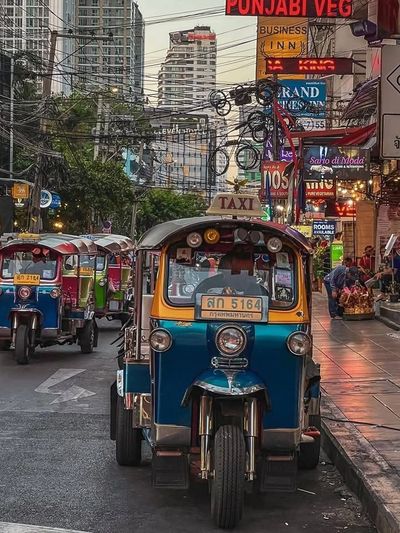
Tuk-tuks are iconic, three-wheeled motorized rickshaws in Thailand, known for their vibrant colors, open-air design, and ability to navigate busy streets, offering a fun but sometimes bumpy, loud, and fume-filled ride for tourists and locals alike, though negotiating fares upfront is crucial as they lack meters. They're a marvelous part of Thai urban transport, serving as an affordable alternative to taxis for short distances, but it's vital to agree on the price before hopping in.
For electric tuk-tuks in Bangkok, MuvMi offers fixed-price, eco-friendly, shared or private rides, while Tuk Tuk Hop provides hop-on/hop-off tourist passes for historic areas.
Ferries and Boats
Ferries operate year-round in Thailand, offering frequent and fast connections across the country and its islands.
One of the best parts about traveling in Thailand is how easily you can hop from one island to the next. Ferries run frequently, connecting numerous different islands, so you can take advantage to transform your vacation into a multi-stop adventure.
You can book ferries in Thailand online via platforms like 12Go Asia, Easybook, Direct Ferries, Thailand Ferry Booking, directly on ferry operator sites (Lomprayah, Raja Ferry, Boonsiri), or locally at hotels, tour agents, and pier counters for last-minute trips, though pre-booking is recommended, especially in peak seasons, to secure seats and packages. Online bookings provide instant confirmation and often include transfers, while local agents offer flexibility and potentially better price
In-Person Booking (Flexible)
- Hotels/Guest Houses: Your accommodation can arrange tickets and transfers.
- Local Tour Agents: Small tour stands everywhere can book tickets and often include shuttle services.
- Ferry Piers: Buy tickets directly at the pier for same-day travel, but be aware ferries can sell out, especially during holidays
Tips for Booking
- Book Ahead: Essential during busy seasons (Nov-Apr) to avoid full boats.
- Check for Transfers: Many online bookings (and local agents) bundle boat tickets with van/shuttle transfers to the pier.
- Compare Prices: Online agents often match or beat counter prices; local agents can sometimes offer better deals.
- Be Prepared: Have your booking confirmation (digital or print) ready for check-in
Tips for getting around
To get around efficiently, use navigation apps (like Google Maps) for public transit, walking, or biking routes, wear comfortable shoes, be aware of surroundings (especially on busy sidewalks or escalators), and also consider bike shares or ferries, always planning around rush hour for smoother travel. Always prioritize safety by staying away from curbs/tracks, taking off backpacks in crowded spaces, and letting people off transport before boarding.
Protect your electronic devices. Wile public Wi-Fi can be incredibly convenient, connecting to the internet at a cafe or airport could put you at the mercy of cyber-criminals. Using a VPN can help you stay safe while connecting to the internet on the go. Nord VPN is a good alternative and have some good discounts. You can find here: https://nordvpn.tpm.lv/r2oPmjAr more info.
Booking ahead of time especially for popular train routes or flights not only that will get you lower price but you will have more chances and options to find availability.
Download apps like Grab or Bolt. Grab is very used in Thailand to book fair priced taxis and motorbike rides and also food order and more.
Bargain with Tuk-Tuk, motorbike and regular taxis to establish a a fare beforehand and to avoid any unpleasant surprise when it comes time to pay or ask the driver of the taxi to use matter.
Thailand, The Land Of Smiles

About Thailand
Thailand, often referred to as the "Land of Smiles," is a captivating country located in Southeast Asia. Renowned for its stunning beaches, ancient temples, vibrant culture, and delicious food, Thailand also offers warm hospitality, showcasing a blend of traditional values and rapid modernization. With a diverse geography that ranges from northern mountains to southern islands, Thailand holds a unique place in history as the only Southeast Asian nation never colonized by Europeans, with a constitutional monarchy centered in Bangkok.
The locals often describe their homeland using the polite term Prtathet Thai (Thai: ประเทศไทย), which translates to "Land of Free." Alternatively, they use the colloquial term Mueang Thai (Thai: เมืองไทย) or simply Thai; the word Mueang, which historically referred to a city-state, is frequently used to denote a city or town as the heart of a region.
Thailand boasts a population of 71.6 million, making it the 20th largest country in the world, with Bangkok as its bustling capital. The nation has a diverse economy, heavily reliant on its thriving tourism sector, which offers unforgettable travel experiences to visitors.
Language: The official language spoken in Thailand is Thai.
Currency: The currency used is the Thai Baht (THB), symbolized as ฿.
Borders: Thailand shares land borders with four neighboring countries in Southeast Asia: Myanmar (to the west/northwest), Laos (to the east/northeast), Cambodia (to the east/southeast), and Malaysia (to the south). It also has maritime borders in the Gulf of Thailand and the Andaman Sea with Vietnam, Indonesia, and India. The borders feature a mix of natural landscapes and some constructed barriers, with recent tensions reported along the Cambodian border.
Principal Airports: Thailand's main international gateway is Suvarnabhumi Airport (BKK) in Bangkok, along with Don Mueang Airport (DMK), which serves as a secondary hub for low-cost carriers. Other key airports include Phuket (HKT) and Chiang Mai (CNX), both essential for facilitating international and domestic travel, managed by Airports of Thailand (AOT).
Driving: In Thailand, drivers keep to the left side of the road, with vehicles having steering wheels on the right, much like in the UK, Japan, and Australia. Visitors from countries such as the US will need to adapt to this driving style, including overtaking on the right and navigating right-hand drive vehicles, while being prepared for a fluid and sometimes unpredictable traffic flow.
Plugs Used: The country utilizes multiple plug types, primarily Type A (two flat pins), Type C (two round pins), and the unique Type O (three round pins arranged in a triangle). Older sockets may also accept Type B (flat pins with ground) or Type F. Most travelers find it necessary to carry a universal adapter due to the variety of plug formats and the higher 220V standard, although Type A/C plugs are commonly found in hotels.
Safety: Generally, Thailand is considered safe for tourists in major areas; however, travelers should exercise caution, avoid conflict zones, and check travel advisories from their country of residence. Staying informed and practicing standard travel safety precautions are always recommended.